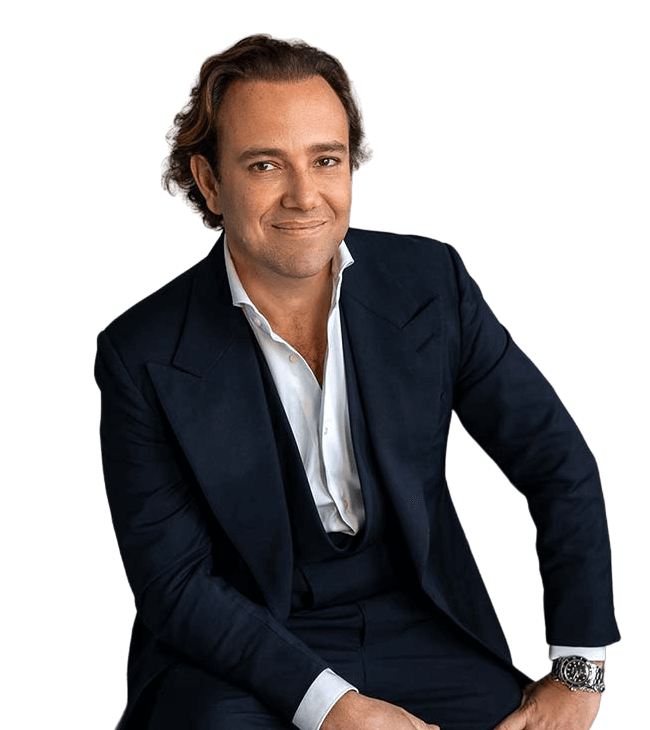
Dr Stefano Cotrufo
Consultant Plastic, Reconstructive and Aesthetic Surgeon
GMC Specialist Register (Plastic Surgery) Member • BAPRAS Member
15+ years of experience
Harley Street, London
Dr Stefano Cotrufo is a consultant plastic and reconstructive surgeon practising from 34 Devonshire Street in the Harley Street medical district. He is listed on the GMC Specialist Register for plastic surgery and is an European Board certified specialist. He trained at the Canniesburn Plastic Surgery Unit in Glasgow, University College Hospital London, the Royal Marsden, and the Royal Free and Royal London hospitals and has undertaken advanced training in facial plastic surgery in the United States with Dr Andrew Jacono himself. He consults on the full range of plastic surgery procedures, including blepharoplasty, facelift, rhinoplasty, and body contouring. So far Dr Cotrufo holds the largest portfolio of Brazilian Butt Lift performed in United Kingdom.
What are hooded eyelids, and can surgery correct them?
Hooded eyelids occur when excess skin on the upper eyelid folds over the natural lid crease, partially covering the eyelashes. The most common cause is dermatochalasis, a gradual loss of skin elasticity with age, though genetics plays a significant role. Surgical correction is called ‘upper blepharoplasty’, a procedure that removes excess skin, muscle and, where appropriate, repositions underlying fat to restore a clearer upper eyelid. Results are long-lasting, typically five to ten years or more, and in cases where the skin obstructs the upper visual field, surgery may be considered functional rather than purely cosmetic. A thorough consultation is always the right starting point.
What Are Hooded Eyelids?
The upper eyelid is a complex anatomical structure. Beneath the skin lie the orbicularis oculi muscle, the orbital septum, and fat compartments, all supported by the levator complex, the mechanism responsible for raising the lid. It is crucial to clarify how the skin of the eyelids is the thinnest of the human body and yet suffers the stress of continuous activity of the underlying orbicularis muscle. The muscle is directly attached to the skin, with no fat interposed between them. The orbicularis oculi muscle keeps contracting all day long while we blink, read, adjust our sight and express our emotions. Let’s accept that this very thin skin grows under a huge amount of mechanical stress all day long. This is why ageing of the eyelids happens faster than many other facial segments. When the skin loses elasticity over time, it can accumulate and fold downward over the natural lid crease, creating the appearance of a heavy or hooded eye.
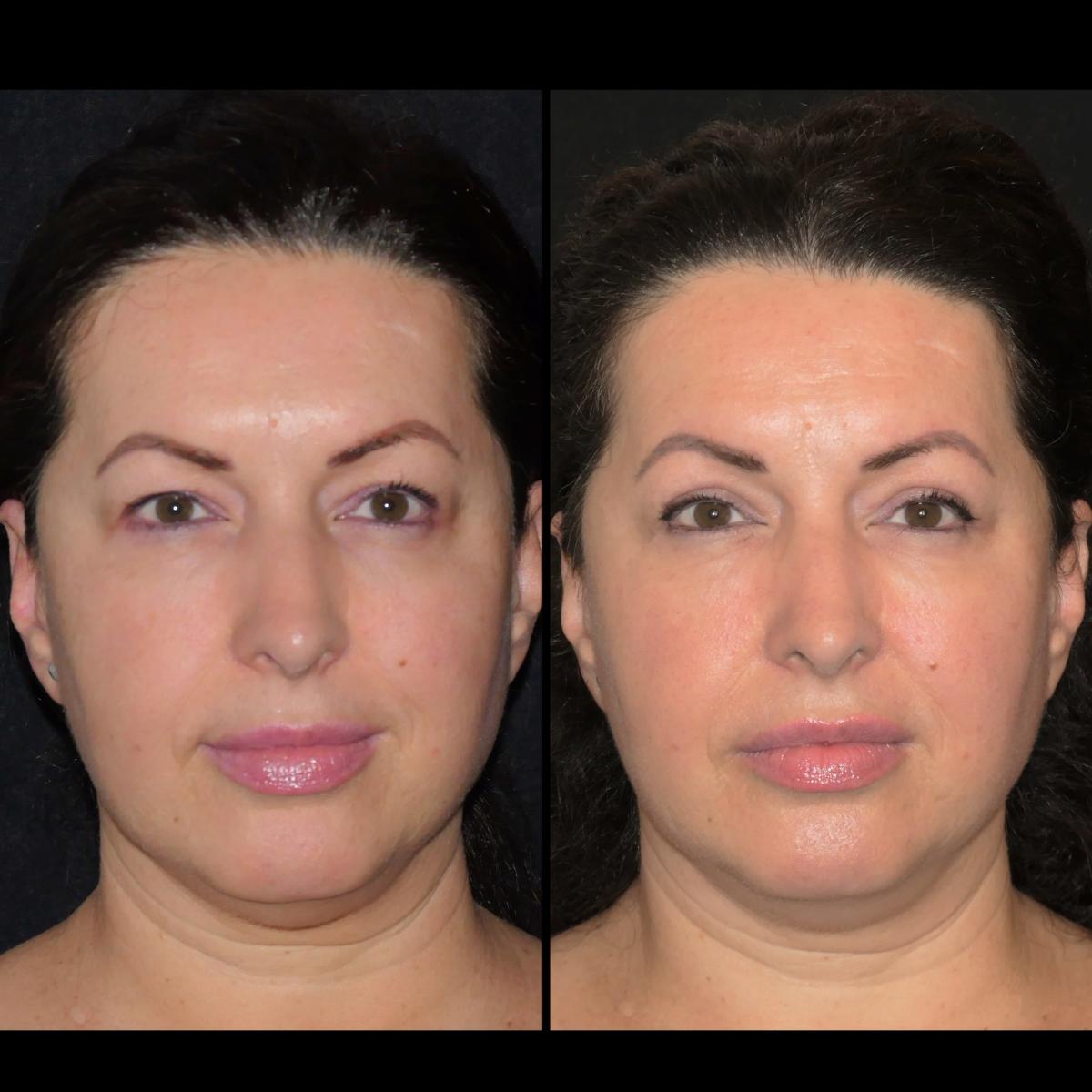
The clinical term for this is dermatochalasis: excess or lax upper eyelid skin. It is more common than most people realise. A large population study published in JAMA Dermatology (the Rotterdam Study, 5,578 participants aged 55 and over) found moderate-to-severe dermatochalasis in approximately 18% of participants. The condition typically begins developing around the age of 40 and becomes progressively more noticeable through the fifties and sixties.
In many cases, this scenario is associated with a drooping of the eyebrows. Sometimes this is also the consequence of progressive laxity of the forehead, but over the last 10 years, I have also seen many cases with brow ptosis due to their regular Botox only; this means that the brow ptosis can be corrected simply by adjusting their Botox dosage and schedule.
What Causes Hooded Eyelids?
The primary driver is ageing. As collagen and elastin in the skin break down, the upper eyelid skin becomes less supportive and begins to descend. Several factors accelerate or compound this process.
Genetics is significant. Research estimates that hereditary factors account for roughly 60% of the variation in the severity of dermatochalasis, which is why patients often notice the same pattern in a parent or sibling.
Sun exposure degrades collagen in the periorbital skin over time. Patients with a history of significant sun exposure often present with more pronounced skin laxity at an earlier age.
Thyroid conditions, particularly hypothyroidism, are associated with periorbital puffiness and can contribute to the appearance of heaviness around the upper eyelid.
Body weight also plays a role. Higher BMI is an independent risk factor for dermatochalasis, likely through its effects on skin tension and fat distribution around the orbital area.
Hooded Eyelids, Drooping Eyelids, and Heavy Brows: Understanding the Difference
This is a distinction I consider important and one that is often overlooked in online content on this subject. Not all hooded or heavy-looking eyelids have the same cause, and the surgical solution depends entirely on an accurate diagnosis.
Dermatochalasis (excess skin) is the most common cause of hooding. The lid margin itself sits at a normal height; it is the skin above that descends and folds (by any degree) over the eyelashes. When the dermatochalasis is more severe, the upper eyelids feel heavy and the appearance is compromised.
Ptosis is a different condition. Here, it is the lid margin that sits too low due to weakness or dehiscence of the levator muscle. The eye appears to have a smaller aperture. Correcting ptosis requires surgery on the levator muscle itself, not simply removal of skin. The two conditions are distinct, though they can coexist. Ptosis correction is a very delicate procedure which requires microscopic separation of the levator muscle (deep) from the orbicularis muscle (superficial) before it is shortened by plication.
Brow ptosis is a third possibility, as mentioned above: the eyebrow descends with age and pushes skin downward onto the upper lid. Operating on the eyelid alone in a patient with significant brow ptosis can worsen the brow position and produce an unsatisfactory result. In many cases brow lifting alone is sufficient to resolve mild to moderate dermatochalasis and my favourite technique is the deep plane approach to the lateral temporal lift.
During a consultation, I examine all three of these possibilities. A careful assessment in front of the mirror, looking at lid margin height, brow position, and the behaviour of the skin under gentle manipulation, tells me exactly which structure is responsible for the appearance the patient finds troubling.
Recently, I met a very fit lady in her 40s who was very dissatisfied with the excess skin of the upper eyelids, which was also heavy on her eyelashes. During the examination, it became obvious that she was unable to lift her eyebrows due to her regular Botox injections in the forehead. It was easy to explain how stopping Botox could be a solution. As she was not keen to see more of her forehead lines, we discussed alternative options, including 1) forehead reduction with incisions within the frontal hairline or 2) direct browlifting (with incisions over the upper edge of the eyebrows). The plan will be confirmed in a few months when the Botox effect is completely resolved and she can be examined again with full competence of the frontalis muscle.
When Do Hooded Eyelids Become a Functional Problem?
For many patients, hooded eyelids are a cosmetic concern. For others, the excess skin descends far enough to obstruct the upper visual field, causing functional problems: difficulty reading, eye fatigue, or a feeling of heaviness by the end of the day.
Surgery can address hooded eyelids, whether the concern is functional, aesthetic, or both. The important thing is that the assessment is thorough before any decision is made.
What Are the Surgical Options for Hooded Eyelids?
Upper Blepharoplasty
Upper blepharoplasty is the most common surgical treatment for hooded eyelids caused by dermatochalasis. The procedure involves making a carefully placed incision along the natural crease of the upper eyelid, removing the excess skin, and, where appropriate, addressing any herniated fat or redundant muscle tissue.
The incision is positioned so that the resulting scar sits within the natural lid fold and becomes imperceptible once healed. The procedure is performed under local anaesthetic in the majority of cases, with sedation available for patients who prefer it. It typically takes between 45 minutes and one and a half hours, depending on whether one or both eyes are being treated and the complexity of the anatomy.
The key principle guiding my approach is that enough skin must always be preserved to allow the eye to close completely. Removing too much skin risks lagophthalmos, the inability to fully close the eye, which can cause corneal exposure and dry eye symptoms. This is why the technical planning is as important as the surgery itself.
Where true ptosis is present, an upper blepharoplasty alone will not achieve the right result. Ptosis repair involves tightening or reattaching the levator aponeurosis (the tendon-like structure that transmits the levator muscle’s action to the lid). This can be done under local anaesthetic, which allows real-time assessment of lid height during the procedure. In my experience, performing ptosis correction under local anaesthetic produces more predictable symmetry than correction under general anaesthetic, because the patient’s active cooperation gives immediate feedback.
Combined Approaches and the Role of Brow Position
Where brow descent is contributing to upper eyelid heaviness, a brow lift, either surgical or through targeted treatment of the forehead musculature, may be considered alongside or instead of upper blepharoplasty. The decision depends on the degree of brow ptosis and what the patient’s priorities are.
As I explain to all my patients considering facial surgery, the areas immediately adjacent to the target zone matter. Treating the upper eyelid without assessing the brow and the lower eyelid can produce a result that draws attention to surrounding areas rather than resolving the concern.
What Should I Expect Before, During, and After Surgery?
Before Surgery
A thorough consultation is the foundation of a good outcome. I take a full medical history. Examine the eyelids carefully in front of a mirror, and explain every technical option available. Patients leave the first consultation with written information covering the procedure, anaesthesia, recovery, and risks. There is no pressure to decide on the day.
Prior to surgery, patients are asked to stop smoking for at least two weeks beforehand and to avoid anti-inflammatory medications (including aspirin and ibuprofen) and alcohol in the days before the procedure, as these increase the risk of bruising and bleeding.
The Procedure
Upper blepharoplasty is performed as a day case. Most patients are comfortable returning home the same day. Local anaesthetic is injected into the eyelid tissue before the procedure begins; patients are awake throughout but feel no pain. Some swelling and bruising begins to appear within hours of surgery; this is normal and expected.
Recovery
Recovery from upper blepharoplasty follows a reasonably predictable timeline.
Days 1 to 3: Swelling and bruising are at their most pronounced. Cool compresses applied gently (not pressed against the eye) help to reduce swelling. Rest and limited screen time are advisable.
Days 5 to 10: Sutures are typically removed within this window if non-dissolvable sutures have been used. Most patients feel comfortable being seen in public from around day seven, though make-up is not advised until the sutures are out and the skin has begun to settle.
Weeks 2 to 4: Residual swelling continues to reduce. Strenuous physical activity should be avoided for at least two weeks.
Months 1 to 3: The scar will appear pink for several weeks before fading to a fine, pale line sitting within the natural lid crease. The final result takes approximately three months to settle fully.
Long-term: Upper blepharoplasty results are durable. Most patients find that results last ten years or longer, though the underlying ageing process continues
What Are the Risks of Upper Blepharoplasty?
Upper blepharoplasty is one of the most commonly performed and well-studied procedures in facial surgery. Overall complication rates in the published literature are low, typically reported at around 5%. The great majority of complications are minor: temporary bruising, swelling, dry eye symptoms, or suture-related issues that resolve with conservative management.
Serious complications are rare. Retrobulbar haemorrhage (bleeding behind the eye) is the most significant potential risk; it is reported at approximately one in 25,000 procedures and requires urgent treatment. Dry eye symptoms can persist for some weeks post-operatively and are managed with lubricating drops; permanent changes to tear production are uncommon.
Patient satisfaction rates following upper blepharoplasty are consistently high across the evidence base.
Frequently Asked Questions
- Are hooded eyelids the same as drooping eyelids?
- Can hooded eyelids be treated without surgery?
- Will the surgery leave a visible scar?
- How do I know whether I need blepharoplasty or a brow lift?
- Is upper blepharoplasty available on the NHS?
- How long do the results of upper blepharoplasty last?
- What is the difference between upper and lower blepharoplasty?
Are hooded eyelids the same as drooping eyelids?
Not always. Hooded eyelids are most commonly caused by excess skin (dermatochalasis), which folds over the lid crease. Drooping eyelids can also be caused by ptosis, a weakness of the muscles that lift the lid. The two look similar but have different causes and require different treatments. A proper clinical assessment is essential before any procedure is planned.
Can hooded eyelids be treated without surgery?
Non-surgical options such as Botox to the brow area can create a modest lift but will not address significant excess skin. For patients with mild hooding and good skin quality, these may provide a temporary improvement. For most patients with true dermatochalasis, surgery is the only treatment that produces a lasting, meaningful result.
Will the surgery leave a visible scar?
The incision is made within the natural crease of the upper eyelid, which means the scar is hidden when the eye is open and minimal when closed. It will appear pink for several weeks post-operatively before fading to a fine line that is not visible under normal circumstances.
How do I know whether I need blepharoplasty or a brow lift?
This is exactly the question a good consultation should answer. I assess brow position and lid margin height as part of every eyelid consultation. Some patients need one procedure, some need the other, and some benefit from both. The answer depends on your individual anatomy.
Is upper blepharoplasty available on the NHS?
NHS funding for upper blepharoplasty is available in cases where excess skin causes a measurable reduction in the upper visual field. Eligibility criteria vary by region. In the majority of cases, patients seeking correction for cosmetic rather than functional reasons will be treated privately.
How long do the results of upper blepharoplasty last?
Results are long-lasting. Most patients find the improvement holds for ten years or more, though the natural ageing process continues and some patients choose to have a second procedure after that time.
What is the difference between upper and lower blepharoplasty?
Upper blepharoplasty addresses excess skin on the upper eyelid, which causes hooding. Lower blepharoplasty addresses the lower lid, typically to reduce under-eye bags caused by herniated fat. The procedures are distinct, though they are sometimes performed together depending on a patient’s anatomy and goals.
If you are noticing heaviness or hooding around your upper eyelids, an assessment with a consultant plastic surgeon is the right first step. A thorough consultation will clarify the cause, explain the options, and give you the information you need to make a considered decision, without any pressure to proceed.
This article is for general information only. It does not constitute medical advice. Please consult a qualified clinician before making any decisions about your care.