Dr Stefano Cotrufo
Consultant Plastic, Reconstructive and Aesthetic Surgeon
GMC Specialist Register (Plastic Surgery) | Member EBOPRAS and CAPSCO
15+ years’ experience
34 Devonshire Street, Harley Street, London
Dr Stefano Cotrufo is a consultant plastic and reconstructive surgeon practising from 34 Devonshire Street in the Harley Street medical district. He is listed on the GMC Specialist Register for plastic surgery and is a European Board-certified specialist. He trained at Canniesburn Plastic Surgery, Thomas, and the Royal Free and Royal London hospitals and has undertaken advanced training in facial plastic surgery in the United States. Eyelid surgery is among the procedures he performs most frequently.

What is blepharoplasty?
Blepharoplasty, or eyelid surgery, is an operation to rejuvenate the eyelids by removing or repositioning excess skin, muscle and fat. Upper blepharoplasty addresses heavy, hooding upper-lid skin, which can also obstruct vision in more advanced cases; lower blepharoplasty addresses under-eye bags and puffiness. It can be performed on the upper lids, the lower lids, or both, usually as a day case, and the results are long-lasting, often lasting 10 years or more. A thorough consultation is the right starting point because it confirms whether the cause is excess eyelid skin, a descended brow, or a drooping lid (ptosis), as each requires a different solution.
What Is Blepharoplasty (Eyelid Surgery)?
Blepharoplasty is a surgical procedure that targets the upper eyelids, the lower eyelids, or both, to remove or reposition excess skin, muscle and fat and restore a smoother, fresher eye contour. The aim is to rejuvenate the eye while keeping it unmistakably your own; done well, it refreshes your appearance without changing your expression. It can be performed on its own or combined with other facial procedures, such as a brow lift or facelift,t for more complete rejuvenation.
Upper vs Lower Blepharoplasty: What Is the Difference?
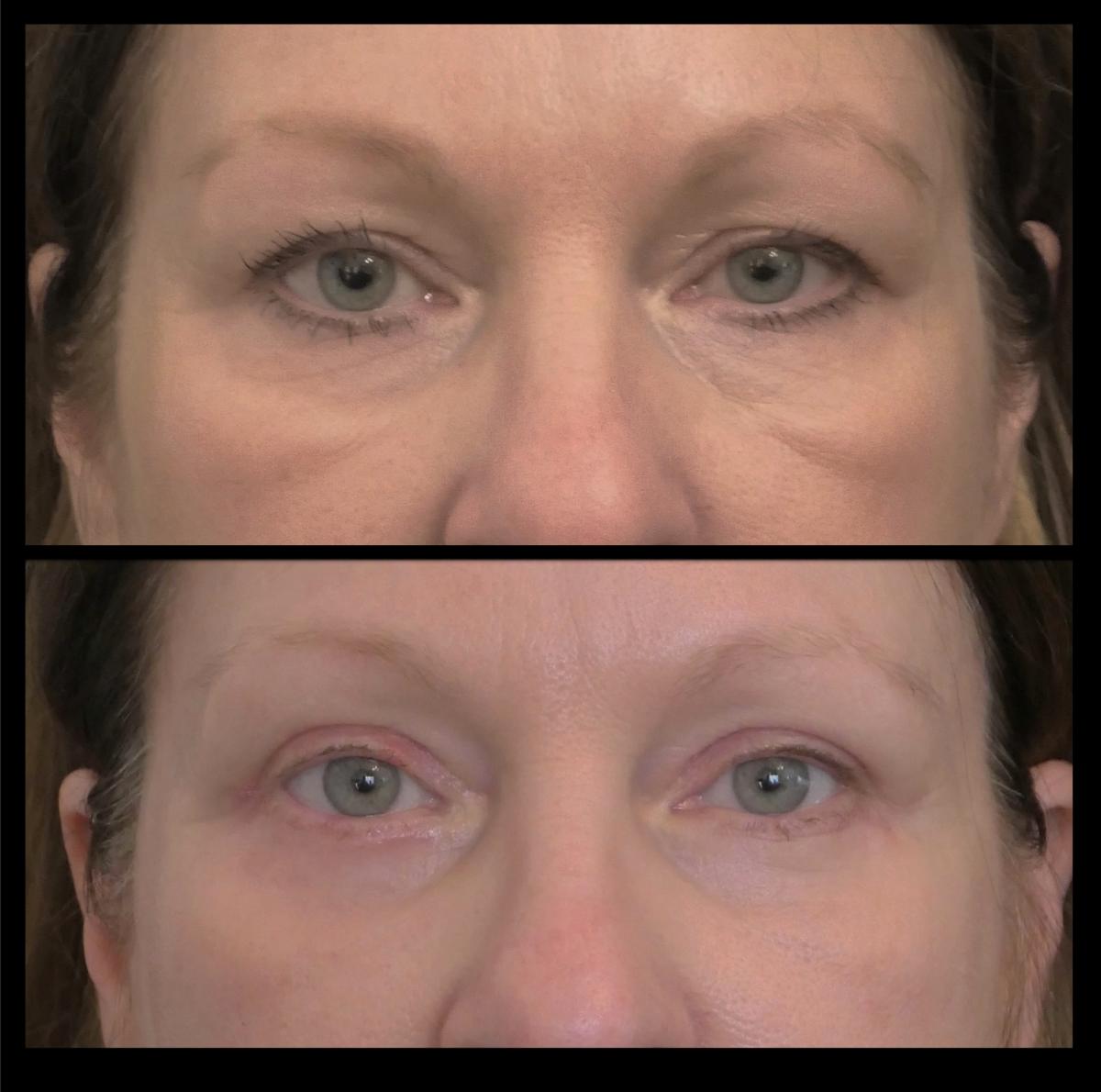
Upper blepharoplasty addresses excess hooding in the upper eyelid that can make the eyes look heavy or tired and, in more advanced cases, obstruct the upper field of vision. The incision is hidden within the natural crease of the upper lid, so the scar becomes very difficult to see once healed.
Lower blepharoplasty addresses under-eye bags, puffiness and loose skin beneath the eye. The incision is placed just below the lash line (1mm) or, in some cases, the inner side of the eyelid so there is no visible external scar (transconjunctival approach). Many people have one or the other; some benefit from both. Which is right for you depends on what is troubling you, and that is exactly what a consultation is for.
What About Hooded Eyes?
Hooded upper eyelids are one of the most common reasons people consider eyelid surgery. In fact, this is probably one of the earliest signs of facial ageing in both sexes. Hooding is usually caused by excess upper-lid skin (dermatochalasis). Still, it can also be driven by a descended brow or a drooping lid margin, and the right treatment depends entirely on which it is. Because this is such a frequent and important question, I have written a separate, detailed guide on hooded eyelids, including how they are assessed and treated. If hooding is your main concern, that article is the best place to start, and we link to it below.
How Is Blepharoplasty Performed?
After a detailed consultation and assessment, the procedure is carefully planned based on your anatomy. For upper blepharoplasty, a precise incision is made along the natural eyelid crease, and excess skin is removed. In most cases, a strip of orbicularis muscle is removed, while bulging fat can be either reduced or transposed. Upper eyelid surgery is often performed under local anaesthetic, sometimes with sedation.
For lower blepharoplasty, the incision is placed below the lash line (usually within 1-2mm) or inside the lid to address bags and puffiness. The procedure typically takes between one and three hours, depending on whether the upper lids, lower lids or both are treated, and most patients return home the same day.
In both upper and lower blepharoplasty,s the incisions extend laterally beyond the outer corner of the eyes (also known as the outer canthus) by 3 to 10mm. This extension is also carefully placed into the most appropriate smile lines (upper, mid or lower)
An essential component of my technical assessment before surgery includes an evaluation of the “lid-to-cheek junction”. In cases where the cheek looks deflated or descended, I recommend combining lower eyelid surgery with a “mid-face lift,” as both operations can be performed through the same incision. The mid-face lift is one of my favourite surgical techniques, performed with a deep-plane approach, and there is a dedicated session on this very powerful procedure for facial “normalisation”.
The guiding principle of my approach is that enough skin must always be preserved for the eye to close completely. Removing too much is the most common cause of a poor or ‘over-done’ result, which is why careful planning matters as much as the surgery itself.
Recovery After Eyelid Surgery
Recovery is usually straightforward. Some swelling, bruising and mild discomfort around the eyes are normal for the first few days and improve over one to two weeks, helped by cold compresses and resting with the head elevated. Stitches are generally removed within about a week. Most patients return to normal daily activities and feel comfortable in public within ten to fourteen days. Strenuous activity, heavy lifting and swimming should be avoided for at least two to three weeks. The fine scar within the eyelid crease is pink at first, fades over the following months, and continues to settle fully over a few months.
Risks and How to Avoid a Poor Result
Searches for ‘botched’ eyelid surgery are common, and they reflect a real concern, so it is worth addressing honestly. Blepharoplasty is one of the most frequently performed and well-studied facial procedures, and in trained hands, serious complications are uncommon; most issues are minor and temporary, such as bruising, swelling, or short-lived dry-eye symptoms. The results people fear, such as difficulty closing the eyes or a hollow or startled appearance, almost always come from removing too much tissue. The best ways to avoid a poor result are to choose a surgeon on the GMC Specialist Register for plastic surgery, to insist on a proper assessment of the brow and lid before any decision, and to favour a conservative approach that preserves enough tissue. I discuss all risks fully at the consultation.
How Much Does Blepharoplasty Cost in the UK?
Cost is one of the most common questions, and the honest answer is that it varies because it depends on whether you are having upper, lower, or both eyelids treated; the complexity of your case; the anaesthetic used; and whether the surgery is combined with another procedure. Upper eyelid surgery alone is at the lower end; treating both lids or combining it with a brow lift or midfacelift costs more. Any figure online should be treated as a guide only.
As with all surgery, the lowest quote is not the thing to optimise for, and very cheap procedures, particularly abroad, can carry real costs in safety and aftercare if a problem arises. At your consultation, I provide a clear, personalised quote covering the surgery, anaesthetic, facility, and aftercare, with no hidden extras.
Is Eyelid Surgery Available on the NHS?
Eyelid surgery is usually performed in the private sector as a form of facial “normalisation”. The NHS may fund upper eyelid surgery only where excess skin causes a measurable obstruction of the upper field of vision, which usually requires a formal visual-field test, and eligibility criteria vary by region. Ptosis, either unilateral or bilateral, is another valid indication to receive treatment through the NHS.
Frequently Asked Questions
- What is blepharoplasty?
- What is the difference between upper and lower blepharoplasty?
- How long does blepharoplasty last?
- Is eyelid surgery painful?
- When can I sleep on my side after blepharoplasty?
- Can blepharoplasty improve my vision?
- Does eyelid surgery help under-eye bags?
- What is double eyelid surgery, and is it the same thing?
- Will eyelid surgery leave a visible scar?
- Can blepharoplasty be combined with other procedures?
- How do I qualify for eyelid surgery on the NHS?
What is blepharoplasty?
Blepharoplasty, or eyelid surgery, removes or repositions excess skin, muscle and fat from the upper and/or lower eyelids to rejuvenate the eyes. Upper surgery addresses hooding skin; lower surgery addresses under-eye bags and puffiness.
What is the difference between upper and lower blepharoplasty?
It varies with whether you have upper, lower, or both eyelids treated and the complexity of your case, so any online figure is a guide only. Upper eyelid surgery alone is at the lower end. I give a clear, personalised quote at consultation that includes surgery, anaesthetic, facility and aftercare. Be cautious of unusually cheap surgery, particularly abroad, where aftercare and revision can become costly.
How long does blepharoplasty last?
The results are long-lasting. Upper eyelid surgery in particular often lasts ten years or more, though the natural ageing process continues over time.
Is eyelid surgery painful?
Most patients report only mild discomfort rather than pain, well-managed with simple pain relief. Swelling and bruising are common in the first week or so but are temporary.
When can I sleep on my side after blepharoplasty?
I advise sleeping on your back with your head slightly elevated for the first one to two weeks, which helps reduce swelling, rather than on your side or front. Your specific timeline is confirmed at your follow-up.
Can blepharoplasty improve my vision?
Yes. When excess upper-eyelid skin obstructs the upper field of vision, upper blepharoplasty can improve both appearance and vision. This is also the basis on which the NHS or your insurance may, in some regions, fund the procedure.
Does eyelid surgery help under-eye bags?
Yes. Lower blepharoplasty is the procedure that addresses under-eye bags and puffiness, by removing or repositioning the fat that causes the bulge and, where needed, tightening loose skin.
What is double eyelid surgery, and is it the same thing?
No, it is different. Double eyelid surgery creates a crease in the upper eyelid and is most commonly sought by people of East Asian heritage who do not have one naturally. Standard blepharoplasty rejuvenates ageing eyelids by removing excess skin and fat. They are distinct procedures with different goals.
Will eyelid surgery leave a visible scar?
The upper-lid incision sits within the natural crease and is hidden when the eye is open; the lower-lid incision is below the lash line or inside the lid. Scars are pink at first and fade to a fine, discreet line over the following months.
Can blepharoplasty be combined with other procedures?
Yes. It is often combined with a brow lift or a facelift for more complete facial rejuvenation, and upper and lower lids can be treated together. I will advise the best combination for your goals at the consultation.
How do I qualify for eyelid surgery on the NHS?
NHS funding is generally limited to cases where excess upper-eyelid skin measurably reduces the upper field of vision, usually confirmed by a visual-field test, with criteria varying by region. Surgery for appearance alone is normally treated privately.
Considering Eyelid Surgery in London?
If your eyes look tired or heavy, or under-eye bags are bothering you, an assessment with a consultant plastic surgeon is the right first step. A thorough consultation will clarify the cause, explain whether upper, lower or both eyelids should be treated, and give you the information you need to decide, without any pressure to proceed. To arrange a consultation at Harley Street, please contact us.
This article is for general information only. It does not constitute medical advice. Please consult a qualified clinician before making any decisions about your care.